When to Replace Your Walking Shoes: Six Signs the Support Is Gone
November 4, 2026
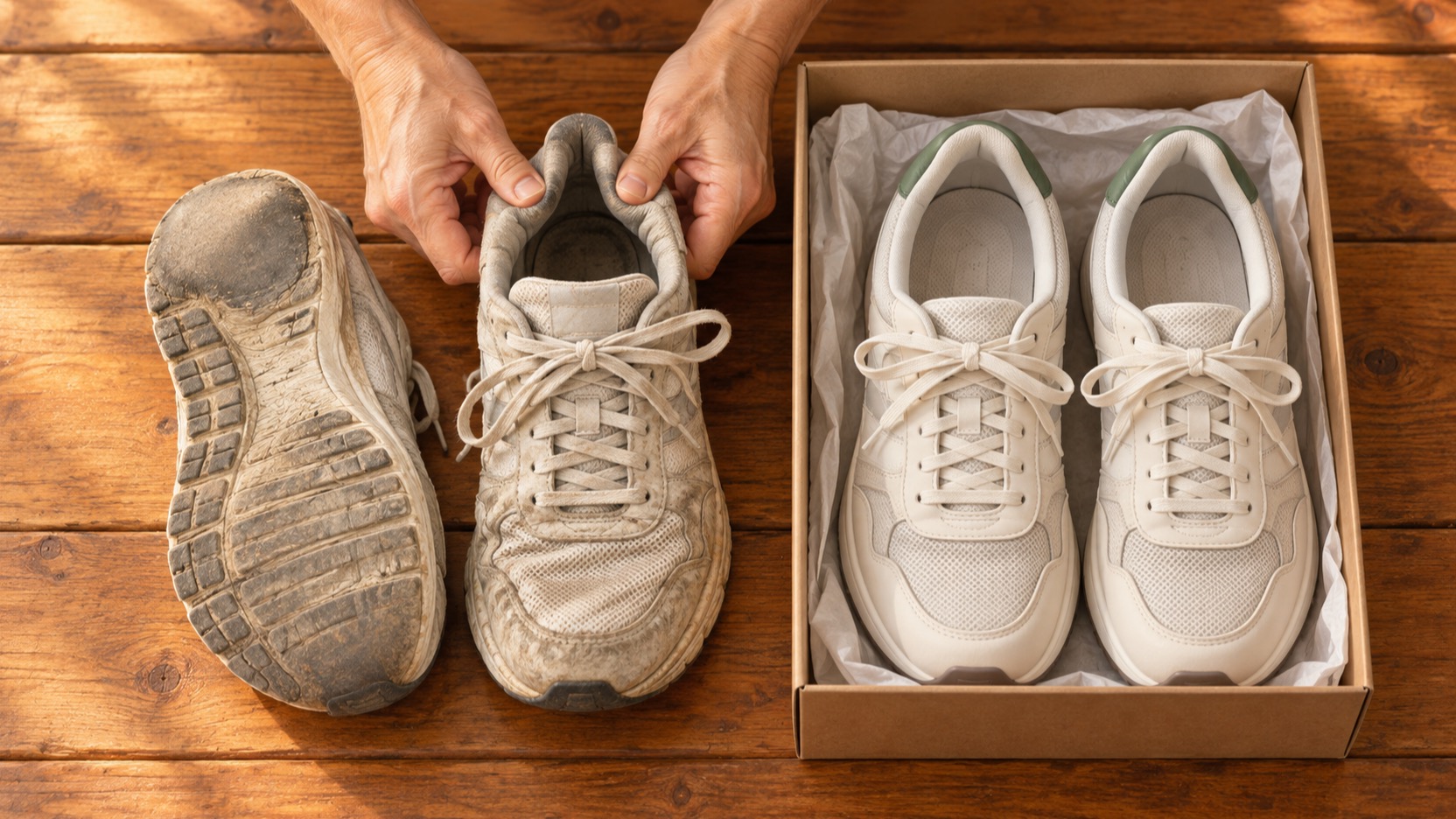
Your walking shoes still look fine from the top. The laces are intact, the color has barely faded, and they are the most comfortable pair you own. But lately your arches ache after the long loop, and your knees notice the downhill stretch.
Walking shoes rarely fail all at once. The cushioning wears out quietly, long before the upper looks tired. Here is how to tell when a pair has done its job, and how to get the most from the next one.
Why good-looking shoes can be worn out
The midsole, the foam layer between the outsole and your foot, does most of the work. Every step compresses it a little, and over hundreds of miles it stops springing back.
The American Academy of Orthopaedic Surgeons' patient site OrthoInfo explains that the EVA foam used in many athletic shoes starts to show structural damage after about 120 miles, and that by 500 miles a running shoe has lost about 45% of its original shock absorption. Walking is gentler than running, but the foam ages the same way.
Podiatrist Stephen Pribut, writing for the American Academy of Podiatric Sports Medicine, makes the key point: cushioning and stability fade gradually, often before the bottom of the shoe shows much wear.
How many miles is a pair good for?
There is no single number, but the experts land in a similar range:
About 400 miles for a good pair of walking shoes, according to physical therapist Michele Dierkes, quoted by Cleveland Clinic.
300 to 500 miles for performance shoes, says Brooks Running, which adds that shoes used for daily walking or work can wear out faster.
About a year as an outside limit for athletic shoes, in guidance from the American Podiatric Medical Association.
To put that in everyday terms: three miles a day, five days a week, is 15 miles a week. At that pace you reach 400 miles in about six months. If you don't track miles, Cleveland Clinic suggests replacing walking shoes about every six months, and Brooks suggests four to six months of regular use.
Walking in the rain shortens the clock. Dierkes notes that shoes wear out faster when they get wet.
Six signs it's time
Use the numbers as a reminder and these checks as the real test.
The tread is smooth. Turn the shoes over. If the pattern has worn flat, especially at the heel or under the ball of the foot, grip on wet leaves and pavement suffers.
The midsole looks compressed. Look at the foam from the side. Deep creases or a squashed, wrinkled look mean it no longer cushions the way it did. Brooks lists a compressed midsole as a clear sign.
The wear is uneven. Set the shoes on a table at eye level and look from behind. If one leans inward or outward, or one side of the sole is worn much more than the other, the APMA says it is time for a new pair.
The heel counter has softened. The firm cup at the back should hold your heel in place. If it collapses easily when you press it, or your heel slides around, support is gone.
The upper is torn or stretched. Holes, fraying near the toes or a heel lining worn through are reasons to replace, says Brooks, even if the sole looks good.
Your body notices. Feet, shins or knees that ache after walks you used to finish comfortably, with no change in your routine, are often the earliest sign. Brooks lists new soreness and a "flat" feeling as reasons to replace.
One quick test: put an old shoe next to a new one, or next to how you remember it feeling in the store. If the old pair feels like walking on a hard floor, believe it.
If pain persists after you switch to a new pair, see a podiatrist or your doctor. Shoes are one cause of foot pain, not the only one.
Make the next pair last
A few habits stretch the life of good shoes:
Wear them for walking. Shoes that double as yard shoes, work shoes and walking shoes wear out on all three schedules at once.
Let them dry at room temperature. Loosen the laces, pull out the insoles and let wet shoes air-dry rather than setting them on a heater.
Loosen the laces to take them off. Stepping on the heel to push a shoe off bends the heel counter, the part that holds your foot steady.
Store spares sensibly. Even unworn shoes age. Brooks notes that adhesives can break down over time, so keep a backup pair in a cool, dry, ventilated place rather than a hot garage. OrthoInfo adds that cushioning can become less effective over time even without use.
Write the date inside the tongue. It takes ten seconds and settles the "how old are these?" question for good.
Some walkers keep two pairs and alternate them, which lets each pair dry fully between walks.
Buying the replacement
When it's time, shop for fit, not just the size on your last box. OrthoInfo recommends trying shoes at the end of the day, when your feet are largest, wearing the socks you walk in, and leaving about half an inch between your longest toe and the end of the shoe. The APMA adds that a good shoe is stiff through the middle but bends at the ball of the foot, and should feel comfortable on the first try.
Our shoe sizing guide walks through fit step by step. If you liked your last pair, buying the same model again is a sensible shortcut. Just check the new version on your feet, since models change from year to year. Our review of the Brooks Ghost 18 shows what to look for in a daily walker.
The takeaway
Look at your walking shoes today. Check the tread, the midsole and the heel, and think back to when you bought them. If they are past six months of regular walking or showing any of the six signs, start shopping now, before your feet make the decision for you.
Educational information only. This article is not medical advice. If you have foot pain, diabetes, circulation problems or a foot condition, ask a podiatrist or your healthcare professional which shoes suit you.
Sources
- OrthoInfo (American Academy of Orthopaedic Surgeons): Athletic Shoes
- American Academy of Podiatric Sports Medicine: Selecting Shoes
- Cleveland Clinic: How to Find the Best Walking Shoes
- Brooks Running: When Is It Time to Replace My Shoes?
- American Podiatric Medical Association: Choosing Footwear (PDF)
- shoe sizing guide
- Brooks Ghost 18